“Inhumane.” “Some sort of Soviet gulag.” “A disturbing and alienating Lovecraftian monster.”
And that’s just from the people who LIKE the Mosse Humanities Building.
Love it or hate it, the grey, brutalist building on the UW-Madison campus at 455 N. Park St. nicknamed the “Inhumanities Building” has been a major part of the college experience for generations of students. Now that the building’s days may finally be numbered, Madison artist Doug E.L. Haynes has captured the unique character and history of the building, and the conflicting opinions about it, in his new illustrated book “The Humanities Building: Do you love it or hate it?”
Haynes met me at the building last week to talk about the book and his release party on Oct. 26 at Leopold’s Books Bar Caffè. (In what was perhaps an unwitting tribute to the building’s notorious labyrinthine structure, Haynes and I first spotted each other standing on different levels of the courtyard, and then spent several minutes trying to figure out which set of stairs would connect us.)
“I don't want people to think that I neglected the opinions of people who hate the building,” Haynes said in an interview in a concrete-bunker-like classroom in the building, featuring a row of tiny skylights covered in blackout tape. “But I think I do have some love. Madison is filled with conventional architecture. There’s a lot of buildings that could be anywhere in the world. They’re forgettable.”
An Architectural Oddity
The Humanities Building is anything but forgettable. Designed by Chicago architect Harry Weese (who also designed the original Chazen Museum of Art building next door) but underfunded by the state Legislature, it’s been plagued with maintenance issues almost since it opened in 1969, known for inadequate ventilation, leaking roofs, temperature issues, and crumbling concrete.
Haynes first came to the building as a West High School student taking summer ceramics classes and was immediately fascinated by it. Later, Haynes attended UW-Madison, where his very first class was in the building, and he spent years sketching in its studios, listening to lectures in its classrooms, and otherwise hanging out.
After finishing his “State St. Adult Coloring Book” during the COVID-19 pandemic, Haynes was looking for another Madison artistic project. He knew that the Humanities Building was scheduled for demolition and wanted to document it, wandering over with his materials with drawing supplies in hand. In the end, the book contains over 100 drawings of the building, everything from its temple-like exterior to to its interior rooms and stairwells.
“One hundred is a lot, but it is a massive building,” Haynes said. “There’s a lot to take in.”
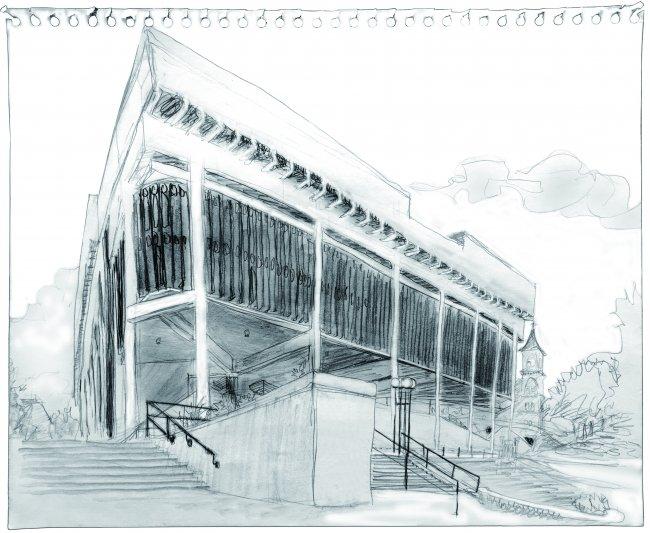
Haynes’ book is filled with sketches of the infamous building, like this one of its exterior. (Photo by Doug Haynes)
Thanks For the Memories
For the text in the book, Haynes conducted a survey online to capture people’s reactions and memories of the building – the good, the bad, and the ugly. The survey is still active and accepting responses. Some respondents write about how they grew to love the distinctive building, while others focus more on the formative experiences they had within its concrete walls. Others just plain hated it.
But if the building is ever finally torn down, Haynes predicts that even the haters might miss the Humanities Building more than they expect to.
“I'm guessing absence will make the heart grow fonder,” he said. “You’ll forget about the musty smells or the cockroaches. A lot of it is about the memories. Even if they hated it, they’re like, ‘This is where I met my wife.’”